Platform compression is brutal on footage that wasn’t exported correctly. A project that looks sharp in CapCut’s preview window comes out soft, murky, or desaturated on YouTube Shorts, Instagram Reels, or TikTok — and the default export settings are a big part of why.
Out of the box, CapCut prioritises smaller file sizes over visual quality. That’s a reasonable default for casual use, but it’s the wrong setting for footage you’ve spent real time grading and timing.
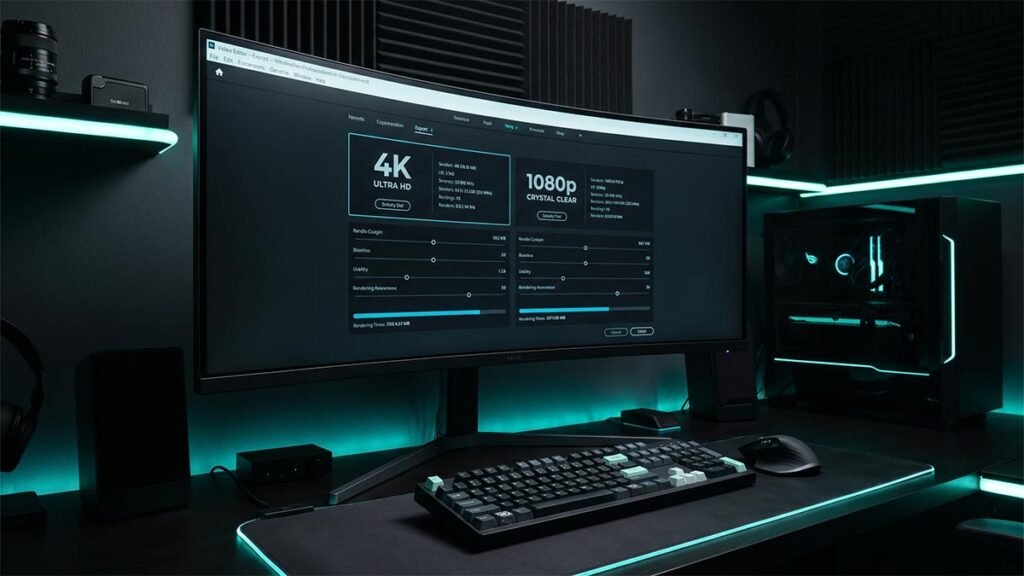
In this complete technical blueprint, you will go through all the possible ways to get the very best out of CapCut Desktop when you hit render every time. Find out how to tweak the final bitrate and other parameters of the hardware acceleration without slowing down your editing machine, from decoding bitrates to unlocking hidden parameters.
Step 1: Access the Export Menu
Before adjusting any internal sliders, ensure you are looking at the correct configuration layout.
- Navigate to the top-right corner of the CapCut Desktop interface.
- Click the blue Export button.
- A large configuration pop-up box will appear. Ensure the Video exporting checkbox is enabled.
Step 2: Configure the Master Video Settings
To achieve a premium, high-definition result that retains high visual data without bottlenecking your system, apply these exact settings in the dropdown menus:
- Resolution: Select 2K/4K if your original source footage was shot in 4K. If you shot your clips in standard HD, choose 1080p. Never upscale 1080p footage to 4K during export, as this introduces pixel artifacting.
- Bitrate: Change this from “Recommended” to Custom, and switch the dropdown menu from CBR to VBR (Variable Bit Rate). Set the slider to Higher. If you prefer a numeric hardcode, aim for 30,000 to 45,000 Kbps for 1080p, and 70,000 to 100,000 Kbps for 4K. This forces CapCut to allocate more data density to high-motion scenes.
- Codec: Choose H.264. While HEVC (H.265) offers smaller file sizes, H.264 provides universal compatibility across web browsers, media players, and social media compression algorithms.
- Format: Select MP4. It is widely recognized as the industry-standard container for web distribution.
- Frame Rate: Select 30fps or 60fps, matching the exact frame rate of your project timeline and source footage.
Step 3: Turn On Hardware GPU Acceleration
Exporting high-bitrate video can intensely strain your computer hardware. To prevent CapCut from freezing at 99% or crashing entirely during the rendering process, let your computer’s graphics card handle the heavy lifting.
- Close the Export window temporarily.
- In the top-left main menu, navigate to Menu > Settings > Performance.
- Check the box for Speed up hardware decoding.
- Check the box for Speed up hardware encoding.
- Click Save, and return to your export project layout.
Export Settings Summary Table
| Export Element | Optimal Selection | Performance & Quality Impact |
|---|---|---|
| Resolution | 1080p (Standard) / 2K/4K (Premium) | Maximum canvas crispness; prevents blurry uploads. |
| Bitrate | Custom → VBR (Higher) | Eliminates pixelation during high-motion action scenes. |
| Codec | H.264 | Provides maximum compatibility across social platforms. |
| Format | MP4 | Universal video container format. |
| Frame Rate | 30fps or 60fps (Match Source) | Ensures smooth playback without micro-stutters. |
Pro-Tips for Social Media Success
The Social Media Trick: Social media platforms like TikTok and Instagram heavily compress large video files upon upload. By exporting with a Higher VBR Bitrate and using H.264, you feed the platform the highest quality data blueprint possible. This ensures that even after their compression algorithm processes your video, your timeline assets stay exceptionally crisp. For a deeper look at industry-standard delivery frameworks regarding color spaces and pixel containers, review the official Google YouTube Video Encoding Specifications to calibrate your master files perfectly.